
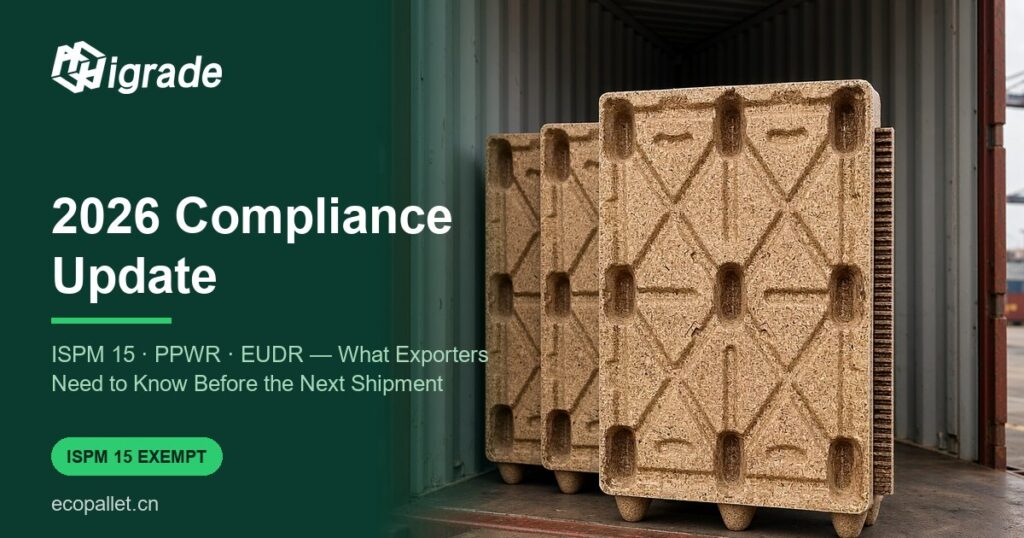
Wood packaging compliance made headlines again in 2026, and the direction is clear: customs authorities are enforcing the rules harder, insurers are quantifying the cost of getting them wrong, and European sustainability law is reshaping what “acceptable packaging” means. For exporters, the pallet under the cargo is no longer a commodity purchase — it is a compliance decision.
This post walks through the three developments that matter most this year and explains why processed presswood pallets have quietly become the default answer for one-way export shipments.
1. The hidden cost of non-compliance is documentation, not pests
In September 2026, the International Union of Marine Insurance (IUMI) published guidance on wood packaging failures in international trade. The finding surprised many exporters: according to the paper, roughly 82% of German export non-compliance notifications between 2023 and September 2025 involved documentation and marking errors — not live pests. Meanwhile, transport insurers continue to attribute around 65% of cargo damage to poorly packed goods.
Read those numbers again. The most common way a solid-wood pallet gets a container detained is not an insect inspection failure — it is a missing, illegible, or incorrectly applied IPPC mark, or paperwork that does not match the packaging. The consequences are expensive regardless of cause: port detentions, emergency re-treatment at destination, forced returns, and missed vessel cutoffs.
This is exactly where processed wood pallets change the risk profile. Molded presswood pallets are manufactured from wood particles bonded under heat and pressure, which places them in the “processed wood” category under ISPM 15. Qualifying processed-wood packaging is exempt from heat treatment, fumigation, and IPPC marking altogether — so the entire class of marking and documentation errors that drives most non-compliance notifications simply disappears. (Exporters should still confirm the classification with their destination market, as the exemption depends on the material and applicable rules.)
2. Europe’s packaging rules are tightening — and presswood fits
Two European regulatory moves in 2026 are worth every exporter’s attention:
- February 2026: The European Commission exempted pallet wrapping and strapping from the EU’s new 100% reuse requirement, keeping one-way palletized shipments practical across EU distribution networks. The broader Packaging and Packaging Waste Regulation (PPWR) still pushes reusable packaging in domestic loops toward 2030 — but one-way export lanes remain open.
- August 2026: A leading European molded-pallet manufacturer issued its EU Declaration of Conformity covering PPWR recyclability and the EU Deforestation Regulation (EUDR) exemption for recycled wood furnish. The signal to the market: pressed pallets made from 100% recycled wood fiber can be documented as EUDR-exempt, which matters for European chemical and machinery export lanes.
The pattern is consistent: European law increasingly rewards packaging with documented recycled content and recyclability, while leaving room for one-way export solutions. A presswood pallet pressed from recovered wood, straw, or bamboo checks both boxes — and gives your customer’s procurement or ESG team a circular story they can actually use in their own reporting.
3. Enforcement at borders keeps getting stricter
Since March 2025, IPPC wood packaging enforcement has visibly intensified across Mediterranean and Eurasian customs checkpoints, accelerating the switch from solid lumber platforms to processed presswood decks. Combined with the IUMI findings above, the practical takeaway for shippers is straightforward: the safest export pallet is one that never enters the ISPM 15 treatment-and-marking system in the first place.
What this means when choosing a pallet
For one-way export shipments, molded presswood pallets offer a combination that solid wood, plywood, and plastic struggle to match:
- No fumigation, no heat treatment, no IPPC stamp — fewer rejected containers and no treatment fees per shipment
- Nestable design — typically around 2.5:1 to 4:1 nesting ratios, cutting return-freight and warehouse space costs
- Nail-free one-piece construction — no loose boards or protruding fasteners to damage cargo or fail inspection
- Recycled raw material — supports PPWR/EUDR documentation and buyer ESG questionnaires
- Consistent dimensions and weight — press molding holds tight tolerances that automated packing lines appreciate
Solid wood still has its place for heavy-duty reusable pooling, and plastic suits closed loops with return logistics. But for the dominant case in international trade — one-way shipments that must clear customs without friction — 2026’s news flow has only strengthened the case for processed presswood.
Checklist before your next export pallet order
- Confirm whether your destination market requires ISPM 15 for your packaging — and whether your pallet qualifies as processed wood (exempt) or regulated solid wood
- If using solid wood, verify the complete IPPC mark: symbol, country code, producer code, and treatment code must all be present and legible
- Ask your pallet supplier for material documentation — recycled content and moisture specifications now matter for EU-bound cargo
- Match the pallet footprint to your destination’s handling equipment, not just your own warehouse
Higrade has molded eco-friendly presswood pallets in Qingdao, China since 2017 — ISPM 15 exempt, nestable, and export-ready, with a full range from 800×600 mm up to 1300×1100 mm. See the complete presswood pallet specifications or request a free quote for your export lanes.