
Presswood Pallet FAQ
Part A
Molded pallets are formed in one piece from wood fibers under high temperature and pressure, giving them a strong, nail-free structure with no joints. Depending on the size and deck type (single or double), typical dynamic load capacity exceeds 2,500 kg and static load capacity exceeds 8,000 kg. Always check the specifications of the exact model against your cargo weight and stacking conditions before ordering.
Yes. Molded pallets are pressed at around 200°C with a finished density of about 1,000 kg/m³, and the moisture content is controlled below 7%. This gives them low water absorption and good dimensional stability, so they resist cracking, warping and mold far better than natural wood pallets in humid warehouse and ocean-freight conditions. They are not designed for long-term outdoor submersion, so standard indoor storage is recommended.
Compared with natural wood pallets, molded pallets are fumigation-free and heat-treatment-free, require no phytosanitary treatment for export, and carry no risk of live insects due to their high-temperature forming process. Compared with plastic pallets, they cost significantly less, stay tough in low temperatures, and are recyclable and biodegradable at end of life. For one-way export shipments, molded pallets usually offer the best overall value.
No. Molded pallets are made of wood fiber compressed at over 200°C and 20 MPa, which qualifies them as processed wood packaging exempt from ISPM 15. They can be exported directly without fumigation, heat treatment or IPPC marking. This saves fumigation costs, avoids quarantine delays at destination ports, and is the key reason molded pallets have become a mainstream choice for export packaging.
Molded pallets are widely used for export container loading, sea freight, warehouse stacking and racking storage. They support four-way or two-way forklift entry and work with both forklifts and hand pallet trucks. Under normal repeated use they last several years, while for one-way export shipments they are the most cost-effective option. Choose the right model by matching dynamic load, static load and entry type to your handling equipment.
Presswood Pallet Questions, Answered
Part B
Short answers to what buyers and specifiers ask before ordering. If your case is not covered, send us the load details and we will answer specifically.
What are presswood pallets used for?
Presswood pallets move and ship heavy industrial cargo: chemical and resin drums, bagged powders, machinery parts and general export freight. Because they are moulded under heat and pressure from recovered wood, they are uniform in size, free of nails and exempt from ISPM 15 heat treatment.
Can presswood pallets carry chemical drums?
Yes. Higrade single-deck pallets are rated to 2,000–2,500 kg dynamic and 6,000–8,000 kg static, which covers four 200–250 kg steel drums per layer stacked three layers high — the configuration shown in the shipment photographs above.
Do presswood pallets need fumigation for export?
No. The wood is sterilised in the press at 200 °C and over 20 MPa, so Higrade pallets are exempt under ISPM 15. Cargo ships into the EU, US, Australia and Japan with no heat treatment, no fumigation and no IPPC stamp.
How much load can a moulded pallet carry?
Single-deck models handle 2,000–2,500 kg dynamic and 6,000–8,000 kg static depending on size; double-deck models handle 2,700 kg dynamic and 8,000 kg static. Density is about 1,000 kg/m³, roughly twice that of a timber pallet.
How many presswood pallets fit in a container?
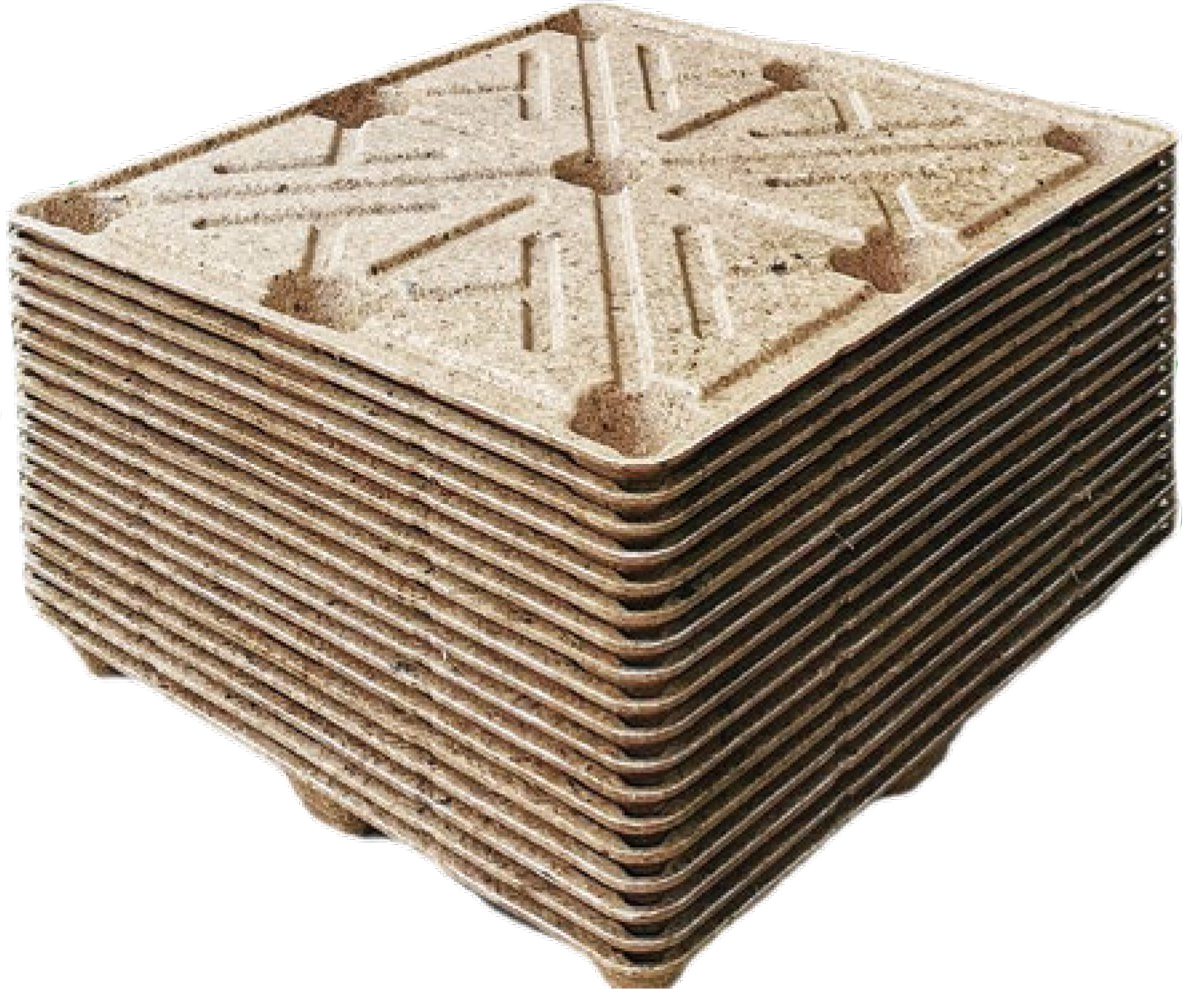
Around 1,650 presswood pallets fit in a 40 ft container, against roughly 450 timber pallets, because the moulded profile stacks flat. That is close to a threefold improvement in container utilisation.
Are presswood pallets reusable?
Yes. Under normal handling a Higrade pallet lasts 20 or more trips. When it finally wears out it can be recycled or returned for reprocessing, so it does not become landfill.