
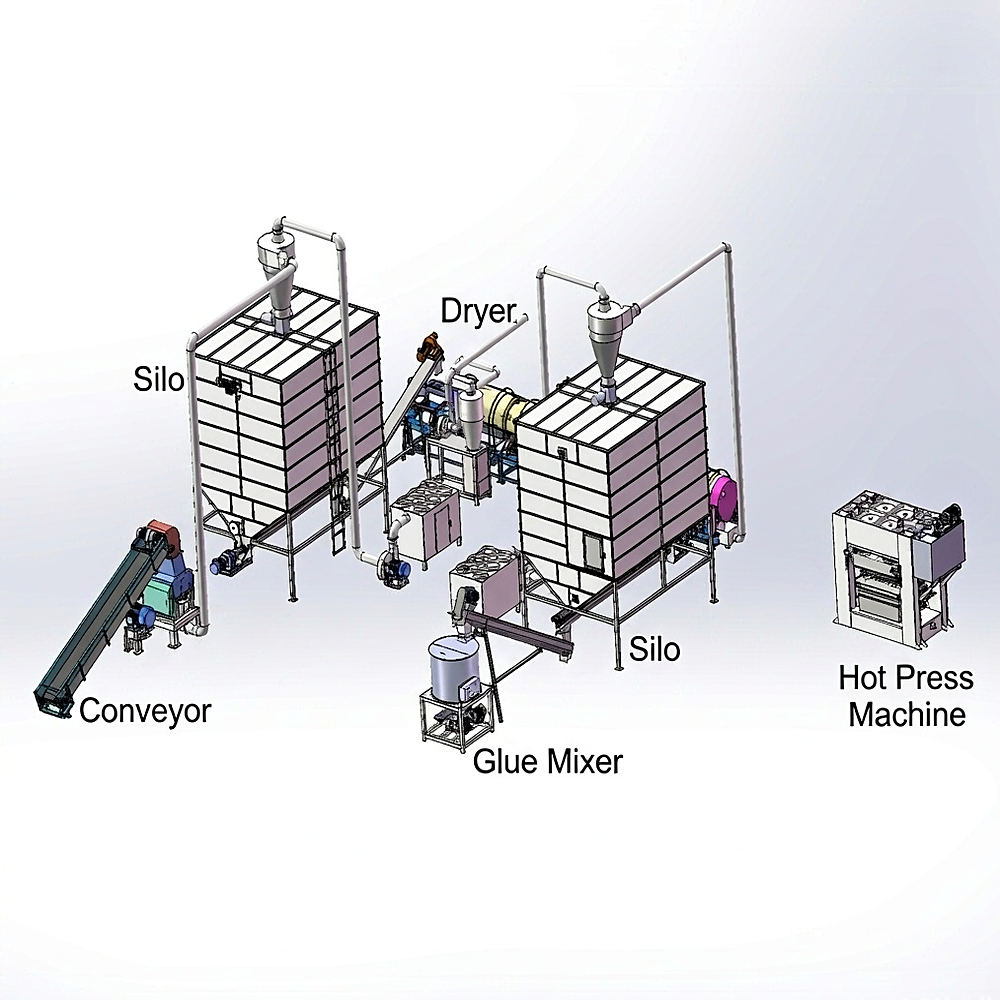
Higrade’s fully automatic presswood pallet production line turns low-cost plant fibre into nestable presswood pallets in one continuous flow. Fibre is stored in a 10 m³ silo and fed by screw conveyor to a 1,200 mm glue mixer, where modified MDI adhesive is atomised and blended by weight. A servo-driven distribution system delivers the mix to automatic forming machines that spread and scrape the mat level inside the mould. A 1,600 T hydraulic press then consolidates the pallet under heat and pressure supplied by a JEOT75 thermal oil heater. Take-out robots lift the finished pallet from the mould and stack it, so line labour is reduced to supervision and feedstock handling. Configuration — number of press stations, forming machines and robots — is sized to your pallet dimensions and target output.
Line Configuration
| Stage | Equipment | Key data |
|---|---|---|
| Storage | Silo | 10 m³; 3,080 × 2,280 × 3,950 mm; screw discharge Ø300 mm, 4 kW |
| Feeding | Screw conveyor | 5.5 kW; 30–60° incline; 4–10 m³/h |
| Gluing | Glue mixer | Ø1,200 × 1,000 mm drum; 11 kW; automatic weighing, glue dosing and discharge |
| Distribution | Automatic distributing system | 4-station, full servo; 7.5 kW; rail-guided discharge trolley |
| Forming | Automatic forming machine | 7.5 kW each; 0.8 m³ hopper; 2 m travel; weighing, release-agent spray, scraping |
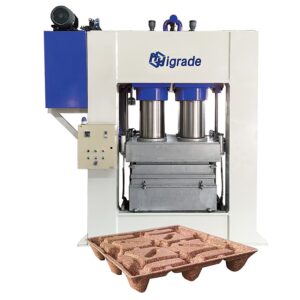
| Moulding | Pallet hydraulic press | 1,600 T; 25 MPa; 700 mm stroke; table 1,800 × 1,450 mm; 45 kW servo |
| Heating | Thermal oil heater | JEOT75; up to 280 °C; PID ±1 °C |
| Take-out | Take-out robot | 2,550 mm arm reach; 50 kg payload; ±0.1 mm repeatability |
| Tooling | Pallet moulds | Designed per pallet size and deck pattern |
Hydraulic Press — 1,600 T
| Main cylinder nominal force | 16,000 kN (1,600 T) |
|---|---|
| Main cylinder working pressure | 25 MPa |
| Main cylinder stroke | 700 mm |
| Maximum daylight (opening) | 1,200 mm |
| Fast approach speed | 180 mm/s |
| Pressing speed | 5–10 mm/s |
| Fast return speed | 180 mm/s |
| Effective table area | 1,800 × 1,450 mm (left–right × front–back, inside columns) |
| Servo motor power | 45 kW |
| Return cylinder force / stroke | 400 kN / 200 mm |
| Frame | Three-beam, all-steel welded construction |
| Control | PLC |
Thermal Oil Heater — JEOT75
| Heat transfer medium | Thermal oil |
|---|---|
| Temperature range | Ambient to 280 °C |
| Temperature accuracy | PID ±1 °C |
| Total input power | 75 kW |
| Pump power / head / flow | 5 kW / 32 m / 16 m³/h |
| Heating method | Direct heating |
| Protection devices | Temperature fault, phase reversal, pump overload, low oil level, abnormal heating |
Automatic Take-Out Robot
| Arm reach | 2,550 mm |
|---|---|
| Repeat positioning accuracy | ±0.1 mm |
| Maximum payload | 50 kg |
| Power capacity | 8.81 kVA |
| Weight | Approx. 725 kg |
| Wrist / body protection | IP54 / IP40 |
How the Line Works, Stage by Stage
Fibre is stored in a 10 m³ silo with screw discharge and fed by incline conveyor to a Ø1,200 mm glue mixer, where modified MDI adhesive is atomised onto the fibre at metered dosage. From there a four-station servo distributing system fills the forming machines, which weigh each charge, spray release agent and scrape the surface level before pressing.
The press is a 1,600 T unit with a 700 mm stroke and 25 MPa working pressure on an 1,800 × 1,450 mm table, heating the mould through a thermal oil circuit running up to 280 °C with PID control accurate to ±1 °C. Mould temperature is what determines cure quality and cycle time, and ±1 °C is tight enough to hold both stable shift after shift. A take-out robot with 2,550 mm reach and ±0.1 mm repeatability removes finished pallets.
The practical consequence of tooling it this way: two operators supervise a process that runs continuously, rather than a crew moving material between stations by hand.
Output, Raw Material and Product Range
- Raw materials — recycled wood fibre, straw and bamboo. Anything lignocellulosic and cheap locally can be evaluated; send us a sample and we will trial it.
- Pallet sizes — moulds are tooled per size and deck pattern. The 1,800 × 1,450 mm table accepts everything from 800 × 600 half-size up to 1300 × 1200.
- Line configuration — the number of press stations is set against your target daily output; we size the equipment list once you give us that figure.
- Total installed power — 75 kW across the line, including the 45 kW servo press drive.
Installation, Training and After-Sales
We deliver the equipment, install it, commission it on your raw material and train your operators before handover. Because we run presswood pallet production ourselves, commissioning includes the process parameters — temperature, pressure, moisture content and adhesive dosage — that our own products are made to.
To quote, we need four things: the pallet sizes and deck patterns you want to produce, your target daily output, available floor dimensions and your local raw material. With those we return the equipment list, layout drawing, utilities specification, price and delivery schedule.
After-sales covers moulds for additional sizes, wearing parts, servo and hydraulic spares, and remote technical support. If your volume does not justify a fully automatic line yet, ask about the 1,000 T hot-press configuration — a lower-capital entry point that can be automated later.
Frequently Asked Questions
What raw materials can the line run?
Any plant fibre that can be blended and hot-pressed — recycled wood, straw, bamboo, cotton stalk and similar forestry or agricultural residues — bonded with modified MDI adhesive. Glass-fibre reinforced material can also be processed.
How many press stations does one line need?
The line is modular. A reference configuration runs four 1,600 T press stations with four automatic forming machines and two take-out robots, fed by one silo, one screw conveyor, one glue mixer and one distributing system, with two thermal oil heaters. We size the station count to your target output.
What output can I expect?
Throughput depends on pallet size, number of mould cavities and pressing time, so it is calculated per project rather than quoted as a fixed figure. Send us your pallet drawing and target daily output and we will propose a matched line configuration.
Do you install and commission the line?
Yes. Equipment is assembled and tested in our factory before shipment, then installed and commissioned on site, with operator and maintenance training during commissioning. The site needs to provide lifting equipment, hydraulic oil, water and power supply.
Reviews
There are no reviews yet.